Does RAM Speed Impact Gaming? A 2025 FPS & Performance Guide
Does RAM Speed Impact Gaming? The Truth About FPS & Performance in 2025
You've built a killer rig. You've got a top-tier GPU and a new CPU, but something's still... off. It's not like your frame rates are tanking, but you keep getting those annoying micro-stutters in the middle of a gunfight or while speeding through Night City in Cyberpunk 2077.
So, is your memory holding you back?
The "does RAM speed matter for gaming?" debate is one of the oldest fights in PC building forums. For years, marketing told us faster RAM means more FPS. Simple. But understanding the true RAM speed impact on gaming in 2025 is a lot more complicated.
It's not just about the big MHz number on the box; it's about latency, how much RAM you have, and how\ your CPU actually uses it.
In this guide, we're cutting through the marketing hype. We'll look at how RAM speed affects your average frame rate and, more importantly, the smoothness of your game (those 1% lows). We'll help you decide if an upgrade is actually worth your money, especially with today's high prices.
The Basics: Understanding RAM Speed and Latency
Before we get into benchmarks, let's get on the same page about what "fast" RAM really means. It's not just one thing. It's a balance between two key factors: frequency and latency.
Frequency (MHz) vs. Bandwidth
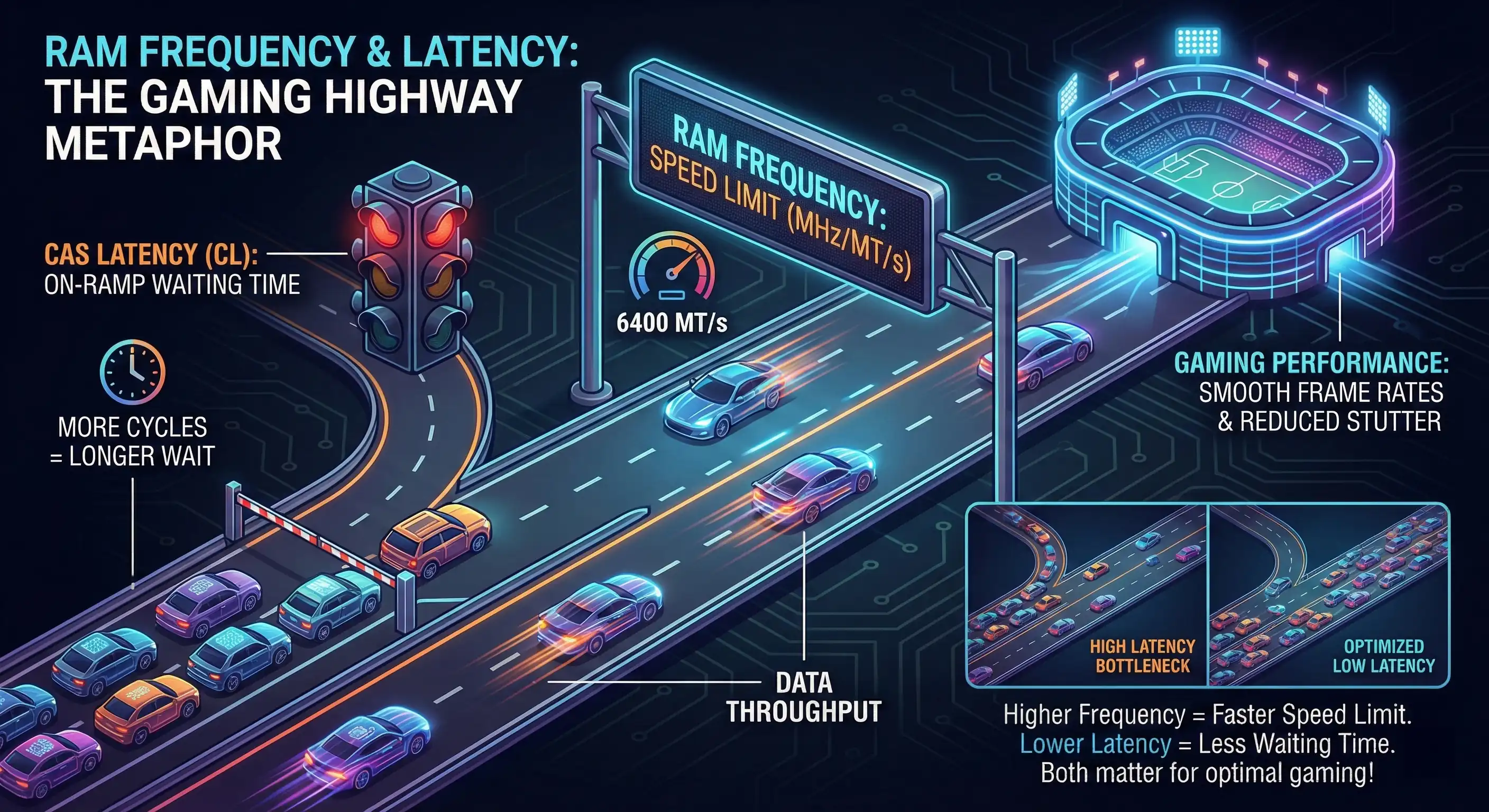
When you see RAM sold as 3200MHz or 6000MHz, that's its frequency. Think of it like a highway's speed limit. A higher number means data can move back and forth more quickly.
This number directly affects bandwidth—how much data can be moved at once. In big open-world games that are constantly pulling in textures and models from your SSD, high bandwidth makes sure there isn't a traffic jam stopping that data from getting where it needs to go.
The Role of Latency (CAS Timings)
But a high speed limit is useless if it takes forever just to get on the highway. That's CAS latency (CL).
CL is the number of clock cycles it takes for the RAM to respond to a request for a piece of data. Here, lower is always better. A RAM kit with CL16 will respond faster than one with CL18.
Here's the thing: you need both. High frequency with low latency is the goal for optimal RAM speed gaming performance.
-
DDR4-3600 CL18: A solid, standard choice.
-
DDR5-6000 CL30: This is the sweet spot for performance in 2025.
If you buy super-high-frequency RAM with terrible latency, you're just wasting money. You want data that moves fast and starts moving right away.
How RAM Speed Impacts Gaming Performance (The Evidence)
Okay, so does all this tech talk actually mean you'll get a better gaming experience? Yes, but maybe not in the way you think. The true RAM speed impact on gaming is often found in game smoothness, not just raw FPS.
Average FPS vs. 1% Lows (Smoothness)
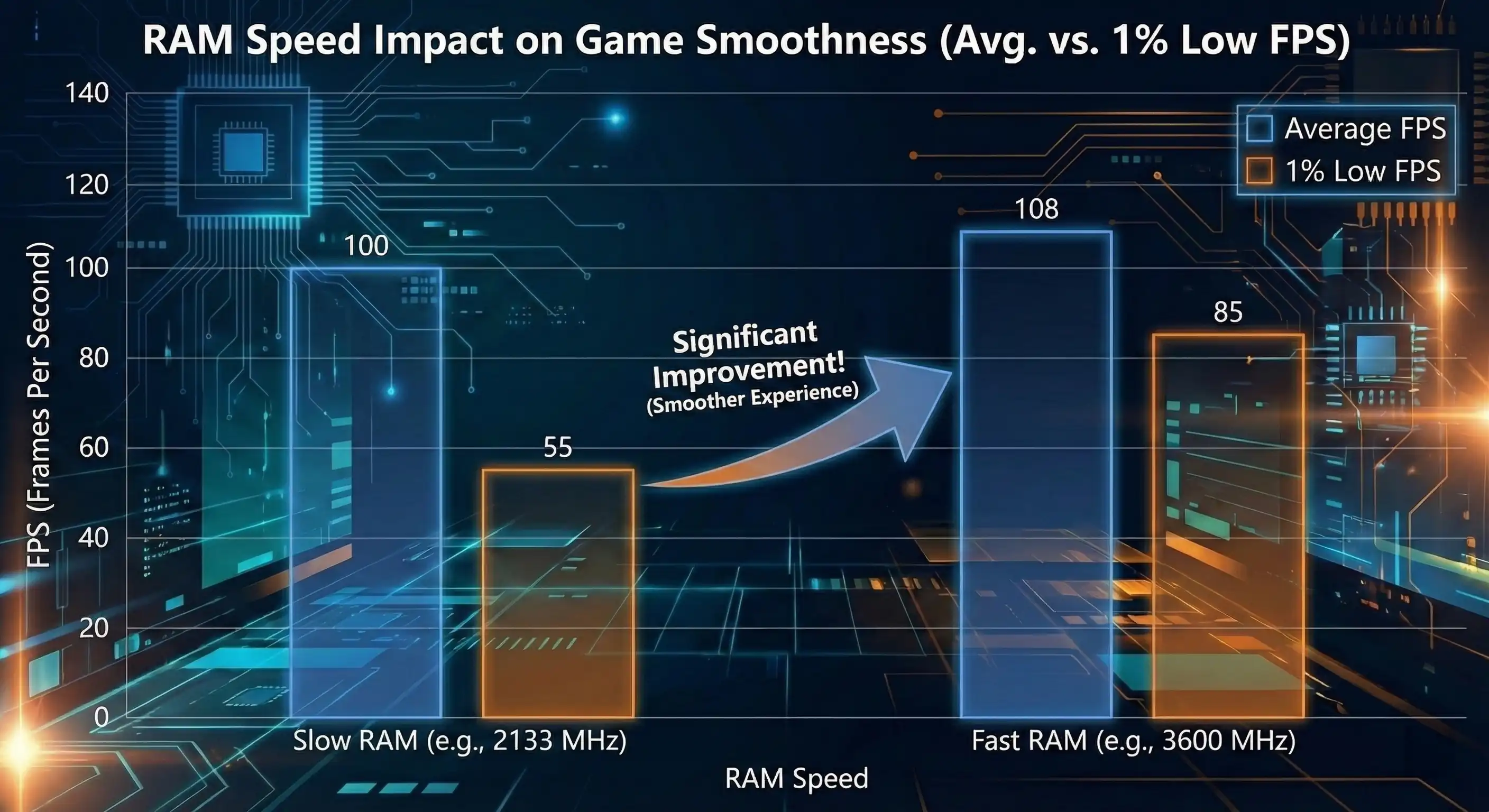
Most people just stare at the average FPS counter. If it says 120 FPS, they're happy. But the real benefit of fast RAM is often hidden in the 1% low FPS.
The 1% low is the average of the worst 1% of your frames. When this number drops way below your average, you feel those nasty micro-stutters.
-
Slow RAM: You might get 100 FPS on average, but your 1% lows drop to 40 FPS. The game feels choppy.
-
Fast RAM: Your average might only go up to 105 FPS, but your 1% lows stay way up at 85 FPS. The game feels buttery smooth.
Tech reviewers like Gamers Nexus and Hardware Unboxed have shown that faster RAM seriously improves frame pacing. In games that hammer your CPU, upgrading from slow RAM to the "sweet spot" can boost those 1% lows by 15-20%. That jerky feeling? Gone. Even if your average FPS only climbs by a little bit.
Impact on Loading Times and Open Worlds
You really see the difference fast RAM makes in games that are constantly loading stuff, like Starfield or Cyberpunk 2077.
If your RAM is too slow, your CPU just sits there waiting for data. This is what causes textures to pop in late or the game to freeze for a split second when you enter a new area. Faster memory speed gaming FPS benefits include seamless texture streaming, so you can stay immersed in the game.
CPU-Bound vs. GPU-Bound Scenarios
How much RAM speed matters really depends on what part of your PC is the bottleneck.
-
CPU-Bound (1080p / Competitive Esports): In games like CS:GO 2 or Valorant, especially at 1080p, your CPU is the one holding things back. In these games, RAM speed is critical. We're talking performance gains of up to 30% with properly tuned DDR5.
-
GPU-Bound (4K / AAA Titles): If you're playing Cyberpunk 2077 at 4K with ray tracing cranked up, your GPU is sweating bullets. It's the bottleneck. In this case, the difference between slow and fast RAM is often less than 5%.
RAM Speed vs. Capacity: Which Should You Prioritize?
If you're on a budget, you might have to choose: faster RAM or more RAM?
The answer is easy.
The "Capacity First" Rule
Speed can't fix a lack of space. If a game needs 14GB of RAM and you only have 8GB, your PC will start using your SSD as emergency memory. This causes huge stutters, and it doesn't matter how fast your RAM is.
The November 2025 Steam Hardware Survey shows how things are changing.
| RAM Capacity | Percentage of Steam Users | Trend |
|---|---|---|
| 16GB | ~41% | Minimum |
| 32GB | ~37% | Growing Fast |
For 2025, just get 32GB. A fast 16GB kit will perform worse than a standard 32GB kit if you're playing a modern AAA game or have anything running in the background.
The Sweet Spot for Gaming
Once you've got enough RAM, aim for these sweet spots. They give you the best bang for your buck without going overboard.
-
For DDR4 users: 3200MHz CL16 or 3600MHz CL18.
-
For DDR5 users: 6000MHz CL30.
Honestly, pushing past DDR5-6400MHz gives you almost no extra performance for the price you pay.
DDR4 vs. DDR5: Is the Upgrade Worth It?
With Intel's newest chips and AMD's Ryzen 9000 series, DDR5 is pretty much standard now. But is it worth the extra cash?
Performance Gap in Modern Titles
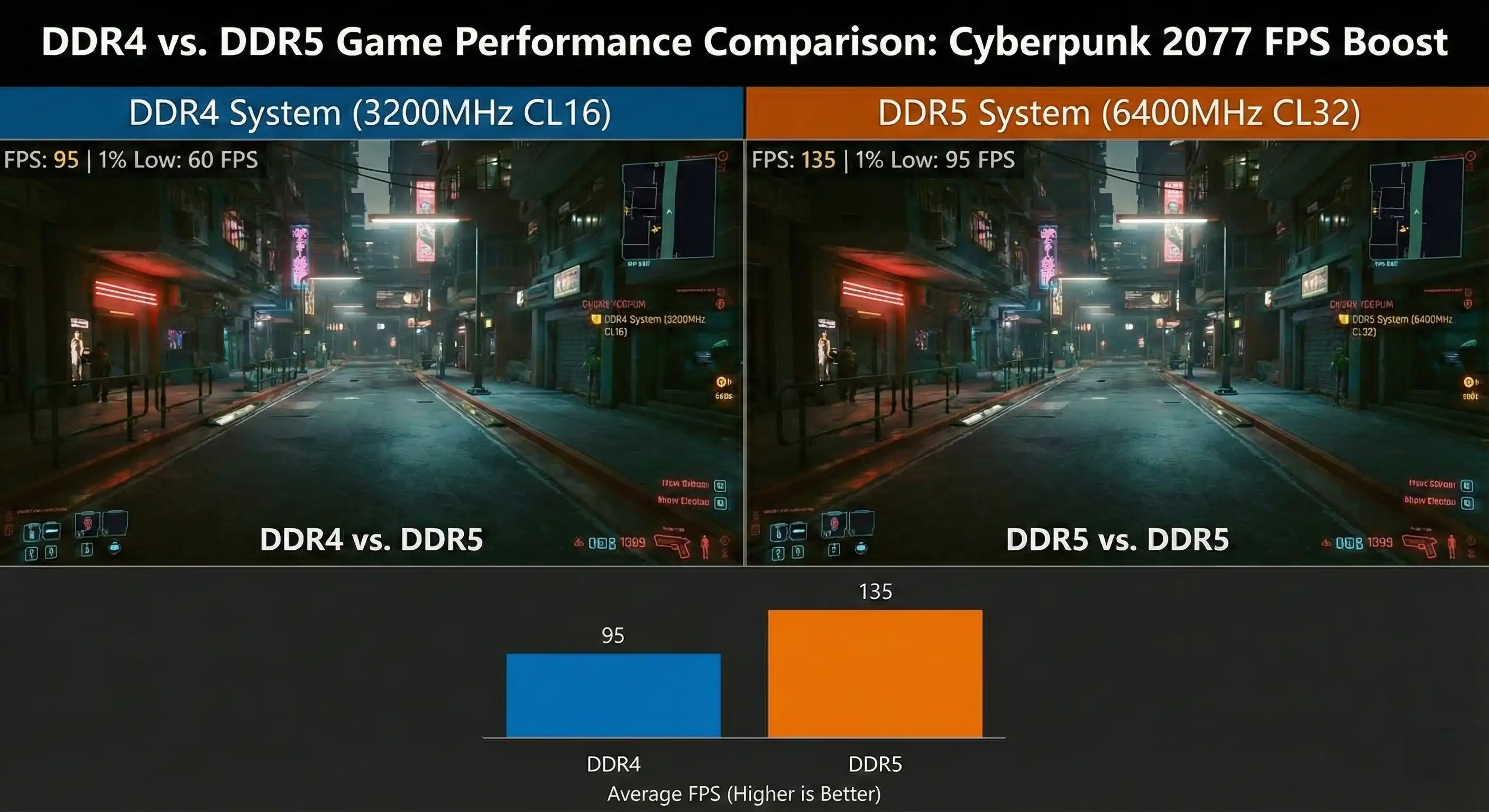
The performance difference between DDR4 and DDR5 in gaming is getting bigger. On average, DDR5 gives you a 15-20% boost in games where your CPU is doing most of the work.
-
Cyberpunk 2077: With an Intel i9-14900K, DDR5 can be around 16% faster than DDR4.
-
AMD Ryzen 7 7800X3D: The difference is smaller (around 4%) because that CPU's giant L3 cache helps hide slow memory.
But let's be real—price is a huge deal. A 2025 DRAM shortage has made DDR5 prices spike. A good 32GB DDR5 kit that was $199 last year can cost you $350-$499 today. Unless you're building a brand new high-end PC, sticking with your fast DDR4 is probably good enough.
Platform Specifics (Intel XMP vs. AMD EXPO)
Make sure your RAM plays nice with your CPU.
-
AMD Ryzen (Infinity Fabric): AMD CPUs are really sensitive to RAM speed because their internal parts talk to each other at a speed linked to your memory via the Infinity Fabric. The sweet spot for Ryzen 7000/9000 is DDR5-6000. Going faster (like 8000MHz) can actually hurt performance by messing up the timing.
-
Intel: Intel chips can handle faster speeds, sometimes up to 7200MHz, but you pay a ton for very small gains after 6400MHz.
Whatever you do, go into your BIOS and enable XMP (for Intel) or EXPO (for AMD). If you don't, that fancy 6000MHz RAM you bought will just run at a sluggish JEDEC default speed like 4800MHz.
How to Check if Your RAM is a Bottleneck
So, is your PC actually being held back by slow RAM? Here's how to figure it out.
Using Diagnostic Tools
You can start by just watching your system while you play. Open up Task Manager or MSI Afterburner and keep an eye on your GPU Usage. It should be pinned at 97-99% pretty much all the time.
If you see it suddenly drop to 60-70% while your CPU usage spikes, or if your RAM usage is hitting 90% or more, you've found a bottleneck. But that only tells you if you have enough RAM, not if it's fast enough.
The Easy Way: Use a Bottleneck Calculator
Guessing what hardware to upgrade is an expensive game. Don't drop $400 on a new RAM kit just hoping it fixes the problem.
Check your setup first. We recommend a tool like a Bottleneck Calculator. It looks at your exact CPU, GPU, and screen resolution to figure out what's holding your system back. It will tell you if your CPU is too slow for your GPU (meaning faster RAM could help) or if your GPU is already maxed out (meaning faster RAM is a waste of money).
Check your PC on a Bottleneck Calculator now – Don't guess; calculate. Find out if RAM speed is your problem before you spend a dime.
Conclusion
So, does RAM speed impact gaming?
Yes. Absolutely. But it affects the smoothness of your game (1% lows) way more than your peak FPS. The overall RAM speed impact on gaming is undeniable, but it's nuanced.
-
For Competitive Gamers (1080p): Fast RAM is a must-have. It cuts down on input lag and those killer micro-stutters.
-
For Visual Gamers (4K): Get more RAM, not faster RAM. 32GB is key. Your GPU is almost certainly the bottleneck here.
-
For Everyone: Go enable XMP/EXPO in your BIOS right now. You're leaving free performance on the table if you don't.
Before you jump into the crazy 2025 RAM market, make sure you actually need an upgrade. Get 32GB of RAM first, aim for that 6000MHz sweet spot if you're on DDR5, and check your system for bottlenecks.
Frequently Asked Questions
Does RAM speed affect FPS significantly?
In CPU-heavy games (like esports titles at 1080p), fast RAM can boost your average FPS by 5-10% and your smoothness (1% lows) by up to 20%. The RAM speed impact on gaming is most noticeable in these scenarios. At 4K, the difference is tiny.
Is 3200MHz good for gaming in 2025?
For a DDR4 system, yes, 3200MHz CL16 is still perfectly fine. It won't hold back most mid-range GPUs and can handle modern games without a problem.
Is faster RAM worth it for gaming if I have a weak GPU?
Probably not. If you have a budget GPU like an RTX 3060, it's the bottleneck. The RAM speed impact on gaming is minimal because your GPU can't even keep up as it is.
Does RAM speed matter for Ryzen processors specifically?
Absolutely. Ryzen's "Infinity Fabric" design is tied directly to your memory speed. To get the best RAM speed gaming performance, DDR5-6000 is the sweet spot for Ryzen 7000/9000 CPUs.
Can I mix different RAM speeds?
You can, but it's a bad idea. Your motherboard will force all the sticks to run at the speed of the slowest one. You'll waste money and might even run into crashes.
What is XMP and should I enable it?
XMP and EXPO are one-click settings in your BIOS that tell your RAM to run at its advertised fast speed. If you don't turn it on, your RAM will run at a much slower default speed (like 4800MHz instead of 6000MHz). Always turn it on to get the performance you paid for.
Is CL16 better than CL18 for gaming?
Yes, CL16 is faster. Lower latency means the RAM responds to your CPU quicker. The FPS difference is small—maybe 1-3 FPS—but it helps make the game feel smoother.
Does RAM speed help with streaming while gaming?
It does. Streaming hits your CPU and memory hard. Having plenty of fast RAM helps your PC juggle playing the game and encoding video without stuttering or dropping frames.
How do I know what RAM speed my motherboard supports?
Go to your motherboard manufacturer's website and find your model. Look for the "Tech Specs" or "Memory Support List" (QVL). It will tell you the fastest RAM frequency for gaming it supports.
Will faster RAM fix game stuttering?
If the stutter is from your CPU being maxed out or from slow asset loading, then yes, faster RAM can make a huge difference. If it's because your GPU is weak or your system is overheating, then no, it won't help.